Do DPF cleaners work? Sometimes. A diesel particulate filter (DPF) fills with two things: soot, which burns, and ash, which does not. An in-tank DPF cleaner, a long run or a garage’s forced regeneration can help a partly blocked filter burn off its soot, especially when short journeys are the cause. None of them removes ash, repairs a cracked or melted filter, or fixes the fault that stopped the filter regenerating in the first place1,3,4. To get the ash out, the filter is normally taken off and cleaned by a specialist, or replaced3,4.
The short answer
- DPF light just come on? The filter is roughly 45% full. A steady drive above 40 mph for about 10 minutes (up to 25) usually lets it regenerate and puts the light out1. In-tank cleaners are sold for this stage6.
- Light ignored, around 75% full: driving will no longer clear it. A dealer or specialist garage has to carry out the regeneration1.
- Around 95% full, or in limp mode: the vehicle can no longer regenerate the filter, and the manufacturer’s guide says the DPF needs replacing1. Specialist off-vehicle cleaning removes ash as well as soot3,11.
- Cost: two UK cleaning services charge £200 and £250 + VAT to clean a filter that has already been removed11,12. Just over half of the 230 DPFs we list cost less than £250 ex VAT. Either way, the filter has to come off and go back on.
- The MOT: a DPF that has clearly been cut open and rewelded fails, unless you can show a valid reason such as cleaning. Keep the invoice8.
Below: why soot and ash need different answers, what the warning light is telling you, every option from a free run to a new filter, what each costs in the UK, the cause to fix first, and what the MOT checks.
Soot burns, ash doesn’t
A DPF is not a flow-through part like a catalytic converter. Its channels are blocked at alternate ends, so the exhaust gas has to pass through the porous channel walls, and the soot particles, too large to follow, are trapped. The vehicle then burns the soot off at high temperature, a process called regeneration, roughly every 300 miles on a healthy vehicle1. Our guide to what a DPF is and how regeneration works covers the basics.
Ash is what regeneration leaves behind. It comes mainly from the additives in engine oil, with some from engine wear and corrosion, and from any metal-based fuel additive used to help the soot burn. It does not burn away: it stays in the filter as oxides and sulphates and slowly raises the resistance to the exhaust flow3,4. Ash collects along the channel walls and in plugs near the back of the filter, which leaves less room for soot. When the engine computer judges the ash restrictive, it can store fault code P242F, “ash accumulation”2.
Ash builds slowly. The emission-control manufacturers’ association reported in 2005 that the first European passenger models with additive-assisted DPFs had the filter replaced with a new or ash-cleaned one at 80,000 km, and that later designs stretched this to 120,000 km and then up to 200,000 km (about 120,000 miles)3. The right engine oil matters: most vehicles with a DPF need a low-ash oil, and the wrong one can cause problems with regeneration1.
What this means for cleaning: anything that helps soot burn can help a filter that is blocked with soot. Nothing that goes into the fuel tank, and no regeneration, can take out ash. A high-mileage filter that is full of ash needs a specialist clean or a new filter.
What the DPF warning light is telling you
The light is a request for help with regeneration, not a sign that the filter has failed. The manufacturer’s DPF guide describes three stages1:
| How full | What happens | What clears it |
|---|---|---|
| About 45% | The engine computer raises the exhaust temperature to burn the soot. If the journey is stop-start, it can’t finish, and the DPF light comes on. | Driving above 40 mph for about 10 minutes, or up to 25 with lots of downhill stretches |
| About 75% | Other warning lights may come on as well. | A regeneration carried out by a dealer or specialist garage |
| About 95% | Limp mode, to protect the engine from the back pressure. | Regeneration can no longer be done; the guide says the DPF needs replacing |
The percentages vary by manufacturer, so follow your handbook first. Peugeot’s 208 handbook, for example, says to drive at a speed of at least 40 mph (60 km/h) until the lamp goes off, and that if it stays on, the level of the DPF additive is low7. On Peugeot, Citroën, Renault and Dacia vehicles a DPF or emissions problem can also show as an anti-pollution warning: see check anti-pollution system.
Why so many DPFs block. In England in 2025, 58% of the trips people drove were under 5 miles, and 78% were under 10 miles10. Short town journeys may never get the exhaust hot enough to regenerate. Gentle motorway cruising in sixth gear can also run too cool, and occasional harder driving in a lower gear is sometimes enough to burn the soot off1.
Your options, from free to a new DPF
1. A steady run (free)
At the first stage, a run at a steady speed above 40 mph for 10 to 25 minutes is the manufacturer’s own advice, and it costs nothing1,7. Only do it where it is safe and legal. If the light is still on afterwards, or comes back within days, something is stopping regeneration: see fix the cause first.
2. An in-tank DPF cleaner
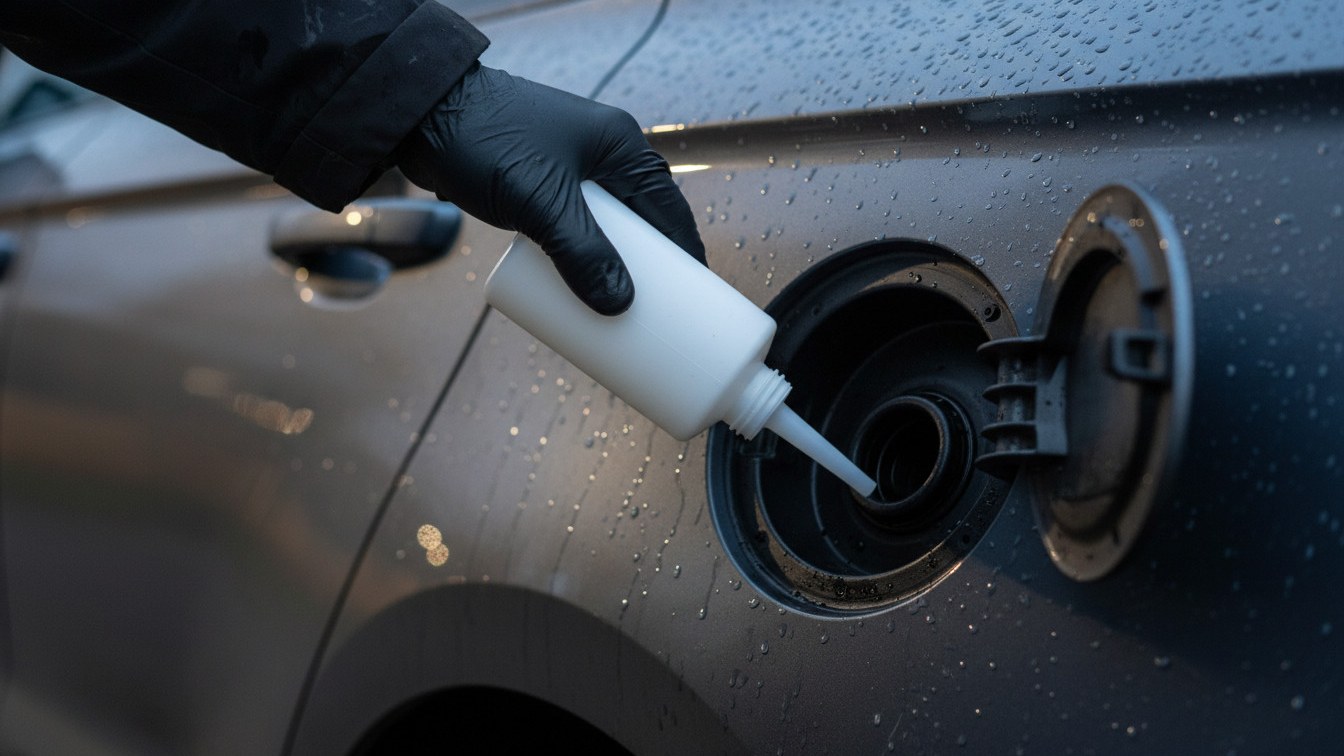
These are additives you pour into the fuel tank. Redex, for example, says its DPF Cleaner contains a “nano-metal oxide catalyst” that lowers the temperature at which soot burns, so that it can burn off during normal driving. It recommends a dose every two to three tanks to prevent blockages, or a dose when the DPF light comes on, then driving as normal6. Those are the maker’s claims.
What an in-tank cleaner cannot do:
- Remove ash. It works by helping soot burn, and ash does not burn. Metal-based fuel additives themselves stay in the filter as ash once the soot around them has burned3, and the manufacturer’s fault code guide lists “overuse of engine and/or fuel system additives” among the possible causes of the ash code P242F2.
- Clear a filter that is past the first stage. At about 75% full, regeneration needs a garage, and at about 95% it can no longer be done1.
- Fix the fault. A failed pressure sensor, a sticking EGR valve or the wrong oil can block the filter again, cleaner or not1.
Check your handbook before adding anything. Peugeot’s 208 handbook authorises only diesel fuel additives that meet its standard B7150007. Some vehicles, Peugeots like the 208 among them, have their own additive tank, usually near the fuel tank, that doses the fuel to help regeneration. That is a different thing from a bottle of cleaner. When it runs low a warning comes on, and the handbook says it must be topped up by a dealer or qualified workshop without delay7; refilling it normally needs the engine computer reprogramming to the new level1.
3. A spray-in clean at a garage
Some garages clean the filter on the vehicle. In Liqui Moly’s Pro-Line method, the technician removes the DPF’s temperature or pressure sensor, waits until the filter is below 40°C, and sprays a litre of cleaner onto the filter through a probe. After about 15 minutes they rinse it with a flushing fluid that spreads the loosened soot through the filter so that it can be burned off by a normal regeneration5. So this method still ends with a regeneration. Liqui Moly itself says cleaning is not always effective: if the filter is overloaded with ash, it must be removed and replaced. It also says to have the work done by a professional, or you risk permanently damaging sensitive components4. Other on-vehicle cleaning services say their chemicals remove ash as well as soot14, so ask what a garage’s method removes before you book.
4. A forced regeneration
Once the filter is around 75% full, a dealer or specialist garage has to carry out the regeneration1, using diagnostic equipment14. Ask what happens if it doesn’t work: one UK booking site for mechanics says its charges for DPF cleaning and regeneration apply whatever the outcome, and that a filter may not be fully restored because of severe clogging, damage to the filter, or other engine or exhaust problems14. Regeneration burns soot; it leaves the ash where it is3.
5. An off-vehicle clean
This is the cleaning designed to remove ash. The filter is taken off the vehicle and the ash is blown out with compressed air from the outlet side while a vacuum collects it at the inlet. Some processes add a controlled bake at 450 to 800°C, over 3 to 12 hours, to burn off any remaining soot. The filter is then checked by probing the channels, weighing it or measuring the air flow through it3. UK services describe their own versions:
- A St Albans workshop inspects the filter with an endoscope and tests its back pressure, cleans it with a two-way water-based wash and drying process, tests it again, and gives a 12-month warranty. It says the process restores the filter unless it is damaged inside11.
- An East Grinstead service inspects the filter, tests its air flow and back pressure before and after, and flushes out the soot, ash and oil. If its inspection finds physical damage, it does not clean the filter. It does not remove or refit filters: your own garage does that12.
Cleaning cannot repair a filter that is cracked or melted. One of the services above will not clean a filter with physical damage, and the other says its process works unless the filter is damaged inside11,12.
6. A new DPF
Replacement is the answer when the filter is cracked, melted or otherwise damaged, when it is past the point where regeneration can be done1, or when a new part costs no more than a clean plus the time off the road. But replacing the filter without finding why it blocked can see the new one fail within 300 miles1.
Cleaning or a new DPF: what each costs
Published UK prices on 31 October 2026. Labour to remove and refit the filter is extra for both an off-vehicle clean and a new DPF.
| Option | Price | What it does |
|---|---|---|
| A steady run | Free | Burns soot |
| In-tank cleaner | A bottle every 2 to 3 tanks6 | Helps soot burn, says its maker |
| Forced regeneration or on-vehicle clean | £300 on average, £160 to £500, says one UK booking site13 | Burns soot; some on-vehicle cleans claim to remove ash |
| Off-vehicle clean (filter removed) | £200 + VAT (£240)11; £250 + VAT (£300) with courier both ways12 | Removes soot and ash |
| A new DPF from us | Most £126.66 to £487.49 ex VAT (£151.99 to £584.99 inc VAT) | Replaces the filter |
| A new combined catalytic converter and DPF from us | Most £262.49 to £685.83 ex VAT (£314.99 to £822.99 inc VAT) | Replaces the unit |
Our ranges cover the middle 80% of the 230 DPFs and 220 combined units we list. 117 of our DPFs cost less than £250 ex VAT (£300 inc VAT), about the same as an off-vehicle clean. A new DPF from us carries a 2-year warranty, or 3 years on Premium silicon-carbide DPFs (a P at the end of the part number); the St Albans clean comes with 12 months11. On many newer diesels the DPF and the catalytic converter are one combined unit, which costs more to replace, so it is more often worth asking for a cleaning quote first. Prices for popular vehicles are in our guide to what a replacement catalytic converter or DPF costs.
Fix the cause first
A blocked DPF is usually a symptom. The manufacturer’s guide says a full diagnosis should be done before the filter is replaced, or the same problem can return soon after1. A cleaned filter goes back into the same conditions, so the same applies to cleaning. The checks it lists include1:
- The DPF pressure pipes and sensor. The engine computer relies on them to manage regeneration2; the pipes must be clear and the sensor working. We list DPF pressure pipes for many vehicles.
- The engine oil. Is it the correct low-ash specification? A level that has risen is a sign of fuel getting into the oil from failed regenerations, and the oil then needs changing.
- The fuel additive tank, where fitted: topped up, with the engine computer set to the new level.
- Sensors, the EGR valve and the engine itself: temperature sensors, the EGR valve and pipe, the air flow meter, turbo and engine wear, leaking injectors, glow plugs and the air filter.
Our guide to why DPFs block goes through the checks in order, and DPF fault codes explained covers P2463, P242F, P2002 and the pressure sensor codes. To stop it happening again, see how to look after your DPF.
DPF cleaning and the MOT
These are the rules in DVSA’s MOT inspection manual for diesel vehicles in England, Scotland and Wales8:
| What the tester finds | Result | Manual section |
|---|---|---|
| A DPF fitted by the manufacturer that is missing, obviously modified or obviously defective | Major (fail) | 8.2.2.1 (a) |
| Evidence that the DPF has been tampered with | Major (fail) | 8.2.2.1 (c) |
| Visible smoke of any colour from a vehicle with a DPF, during the smoke test | Major (fail) | 8.2.2.2 (d) |
| Smoke above the limit on the manufacturer’s plate or the default limit | Major (fail) | 8.2.2.2 (a), (b) |
| Engine management light on, on a diesel first used from 1 July 2008 | Major (fail) | 8.2.2.2 (g) |
Cut open and rewelded. The manual tells testers to reject a DPF that has clearly been cut open and rewelded “unless the vehicle presenter can show evidence that there was a valid reason to cut it open, such as for filter cleaning”8. If a cleaning service opened your filter, keep its invoice with the vehicle’s papers.
Smoke limits. The tester uses the limit on the manufacturer’s plate. Without one, the limit is 1.5 m-1 for a diesel first used from 1 July 2008 to 31 December 2013, and 0.7 m-1 from 1 January 20148. On a vehicle with a DPF, visible smoke of any colour during the test is a fail in itself.
Removing the DPF instead. If a vehicle was built with a DPF and doesn’t have one now, it fails the MOT9. See DPF removal and the law. If your vehicle has already failed on smoke, our post on failing the MOT on emissions explains the readings.
If you need a new DPF
- Type approval. A replacement DPF fitted to a Euro 5 or later vehicle (registered from 1 January 2011, and some earlier ones) must be type approved. Euro 4 and earlier vehicles can take one that is not9. See type approval and the law.
- What we list. 230 DPFs, 220 combined catalytic converter and DPF units, and 13 combined SCR and DPF units. 228 of our DPFs come with a fitting kit included. Many come in a Premium silicon-carbide version: see our part numbers explained.
- Fitting. Fit it with a new fitting kit, check the pressure sensor hoses, and use no sealant or exhaust paste. Afterwards, the fault codes are cleared, the engine computer is reset and a forced regeneration is carried out, so that it recognises the new filter1,2. Our guide to replacing a DPF takes you through it.
DPFs for popular diesels
How many DPFs and combined units we list for each model on 31 October 2026. Each page lists every part by engine, with today’s price.
| Vehicle | DPFs | Combined catalytic converter and DPF |
|---|---|---|
| Ford Focus | 4 | 17 |
| Audi A3 | 15 | 6 |
| Volkswagen Golf | 12 | 5 |
| Ford Mondeo | 4 | 12 |
| Skoda Octavia | 10 | 5 |
| Peugeot 308 | 6 | 7 |
| Vauxhall Astra | 2 | 8 |
| Nissan Qashqai | 6 | 3 |
| Citroen Berlingo | 4 | 5 |
| Ford Transit | 0 | 7 |
Every part lists the vehicles and years it is catalogued for, so check it against your vehicle. All carry a 2-year warranty (3 years on Premium silicon-carbide DPFs), are backed by our fitment guarantee, and come with free delivery to most of the UK, next working day on orders placed before 4pm, Monday to Thursday. Browse DPFs and combined catalytic converter and DPF units, or choose your vehicle from the vehicle list.
Frequently asked questions
Do DPF cleaners work?
They can help a filter that is partly blocked with soot to regenerate, which is what their makers claim6. They cannot remove ash, which no regeneration burns3,4, they cannot clear a filter that is past the point of regeneration, and they do not fix the fault that blocked it1.
Will a DPF cleaner turn off the DPF light?
Only if the soot then burns off. When the light first comes on, a steady drive above 40 mph for about 10 to 25 minutes is the manufacturer’s advice1. If the light stays on, check your handbook: on some vehicles it means the DPF additive tank is low7.
How much does it cost to clean a DPF?
Two UK services charge £200 + VAT and £250 + VAT to clean a filter that has been removed, plus your garage’s labour to remove and refit it11,12. One UK booking site gives an average of £300, from £160 to £500, for cleaning and regeneration13.
Can I clean a DPF myself?
You can pour in an in-tank cleaner and take the vehicle for a run. Spray-in cleaning and off-vehicle cleaning are specialist jobs: Liqui Moly warns that doing it yourself risks permanently damaging sensitive components4, and ash blown out of a filter has to be collected with dust extraction while the technician wears eye protection, a dust mask and gloves3.
Will a cleaned DPF pass the MOT?
It is judged like any other DPF. Visible smoke of any colour during the smoke test is a fail, and so is a filter that has clearly been cut open and rewelded, unless you can show a valid reason such as cleaning: keep the invoice8.
How often does a DPF need cleaning?
Soot is meant to burn off by itself roughly every 300 miles1. Ash takes far longer: the early additive-assisted systems on European passenger models were serviced at 80,000 km, and later designs at up to 200,000 km (about 120,000 miles)3. Engines that burn more oil fill with ash faster3.
Can I just remove the DPF?
No. A vehicle built with a DPF fails the MOT without one9, and evidence of tampering is a major defect8. See DPF removal and the law.
Enter your vehicle below to see the DPFs and combined units catalogued for it.
Sources (accessed 31 October 2026)
- BM Catalysts, “Diesel Particulate Filter Information & Fitting Advice” (DPFFA_V01): overview, installation guide, initial investigation and diagnostic checks. bmcats.com
- BM Catalysts, “DPF & Catalytic Converter Common Fault Codes Guide” (FAULTCODES_V01, January 2024): introduction and P242F. bmcats.com
- Manufacturers of Emission Controls Association (MECA), “Diesel Particulate Filter Maintenance: Current Practices and Experience”, June 2005, sections 3.0 to 3.5; published by Transport Canada. tc.canada.ca
- Liqui Moly, “Diesel particulate filter cleaning” (information for drivers). liqui-moly.com
- Liqui Moly, “Pro-Line Diesel Particulate Filter Cleaner” (part no. 5169), and product information for “Pro-Line Diesel Particulate Filter Purge” (part no. 5171, PI 24/13/08/2018). liqui-moly.com
- Holt Lloyd International, “Redex DPF Cleaner” (product page and questions). redexadditives.com
- Peugeot, 208 handbook, edition 01-16 (June 2015 to January 2017): “Particle filter”, “Diesel additive” and “Compatibility of fuels”. public.servicebox.peugeot.com
- DVSA, MOT inspection manual for private passenger and light commercial vehicles, section 8: Nuisance (8.2.2.1 Exhaust emission control equipment; 8.2.2.2 Opacity), updated 14 October 2026. gov.uk
- Department for Transport, “Catalytic converters and diesel particulate filters” (guidance, updated 30 May 2023). gov.uk
- Department for Transport, National Travel Survey, table NTS0308b: trips by trip length and main mode, England, 2025 (car or van driver; updated 10 September 2026). gov.uk
- SCC Performance (St Albans Car Clinic), “DPF Cleaning” (DPF cleaning centre; product code DPFCLEAN). focusrsparts.co.uk
- DPF Fixer Ltd, East Grinstead, “Off-car DPF & CAT cleaning”. dpf-fixer.co.uk
- ClickMechanic, “Diesel particulate filter (DPF) cleaning, regeneration and replacement” (price estimates). clickmechanic.com
- ClickMechanic, “Diesel particulate filter (DPF) cleaning and regeneration: options and charges” (help article 932). clickmechanic.com