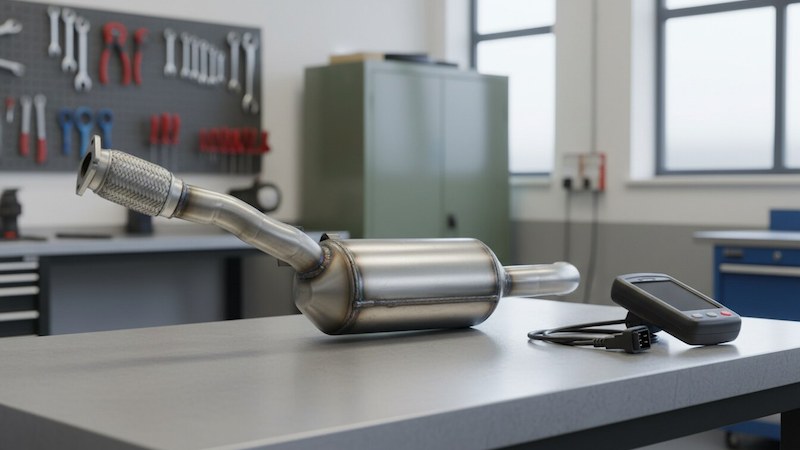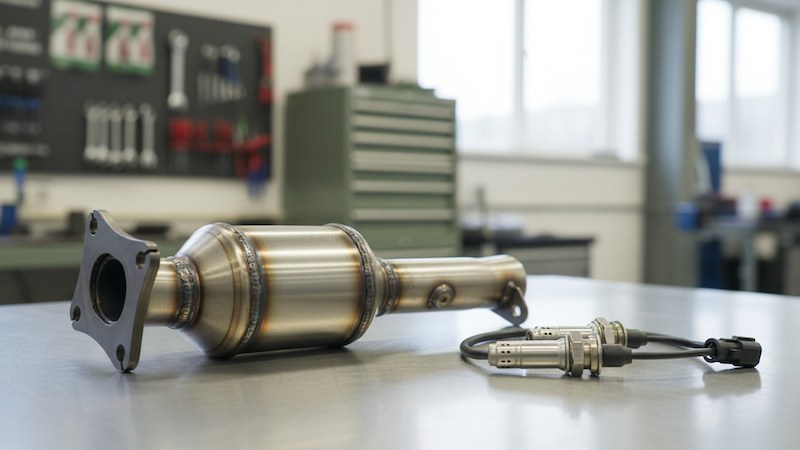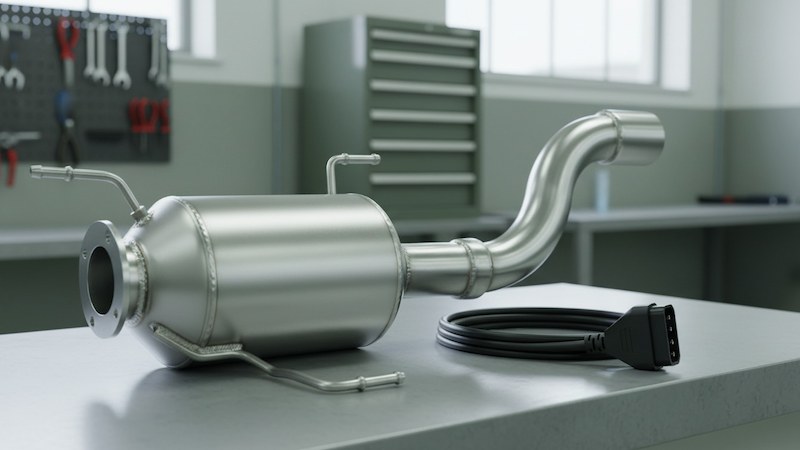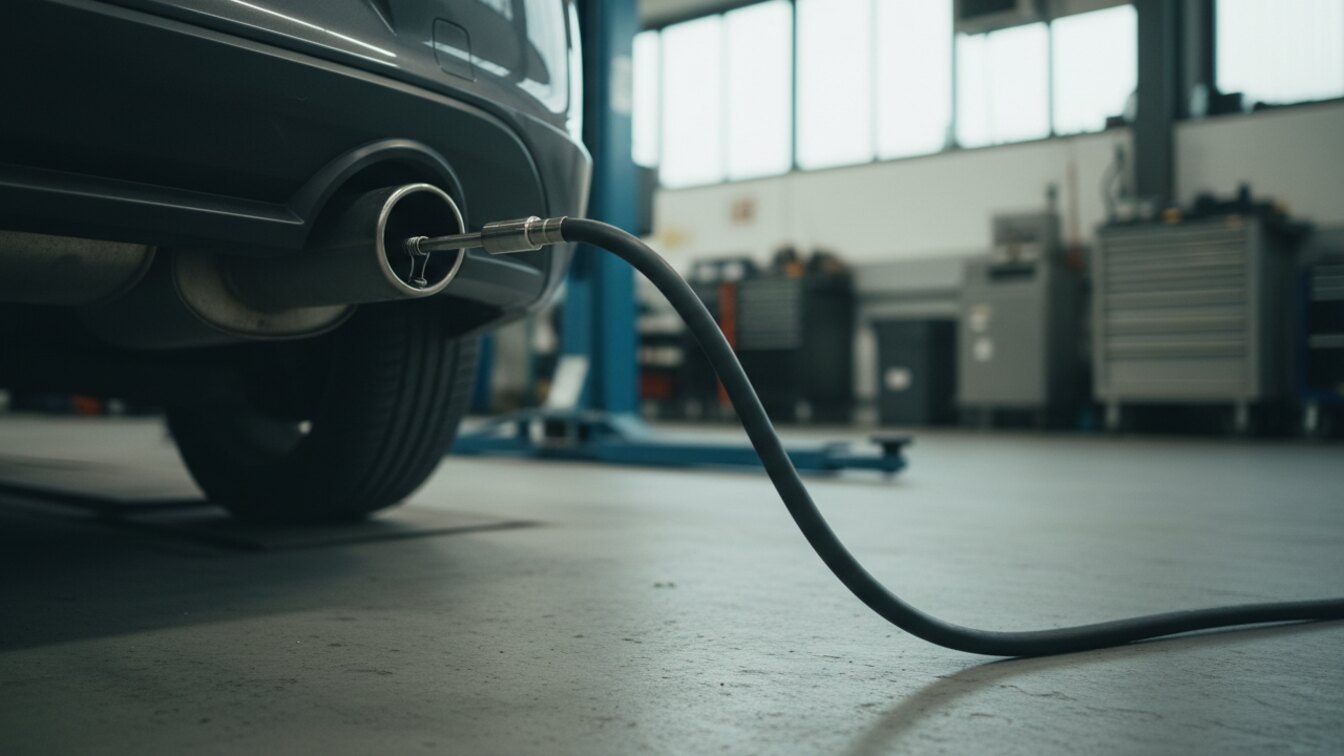
An MOT emissions failure means one of three things: the exhaust gas from a petrol engine, or the smoke from a diesel, measured above the limit for your vehicle; the tester saw smoke; or emission-control equipment such as the catalytic converter or DPF is missing, modified or obviously faulty1. It does not automatically mean the catalytic converter or DPF needs replacing. The readings on your emissions printout usually point to the cause, and the cause has to be fixed first, or a new part can fail the same way6.
The short answer
- Petrol, high CO with low HC: the catalytic converter is not converting the gas properly.
- Petrol, high HC: an engine fault is putting unburned fuel into the exhaust. Fix that before anything else.
- Petrol, lambda outside 0.97 to 1.03: the air and fuel mixture is wrong. It is not always the lambda sensor.
- Diesel, smoke over the limit: check how the engine is burning its fuel. On a diesel with a DPF, any visible smoke is a fail on its own.
- Keep the printout, fix the cause, and have the vehicle retested within 10 working days.
What the MOT emissions test checks
Petrol vehicles
Petrol vehicles first used from 1 August 1975 have their exhaust gas measured at the tailpipe1. With the engine warm, the tester holds it at a fast idle of 2,500 to 3,000 rpm and records carbon monoxide (CO), hydrocarbons (HC) and lambda, then lets it drop back to normal idle and records CO again. In this basic test the vehicle passes if all four readings are inside these limits1:
| Reading | Basic test limit | What it measures |
|---|---|---|
| CO at fast idle | up to 0.2% | Carbon monoxide, a poisonous gas the catalytic converter should turn into carbon dioxide |
| HC at fast idle | up to 200 ppm | Hydrocarbons: fuel that left the engine unburned |
| Lambda at fast idle | 0.97 to 1.03 | The balance of air and fuel; 1.00 is the ideal mixture |
| CO at normal idle | up to 0.3% | Carbon monoxide again, at tickover |
If the vehicle does not pass the basic test, the tester runs a fuller test against the limits for that vehicle: the manufacturer’s own figures where DVSA’s database holds them, otherwise default limits that depend on the vehicle’s age1. That is why a result can read “Emissions levels exceed the manufacturer’s specified limits” or “Emissions levels exceed default limits”. Both are major defects, and so is a lambda reading outside the range1. Dense blue or clearly visible black smoke for five seconds at idle is a separate major defect1.
Diesel vehicles
Diesels are smoke-tested: the tester revs the engine several times and a smoke meter measures how much light the exhaust smoke blocks, a figure in m-11. The limit is the value on the manufacturer’s plate, which is often in the engine bay. Where there is no plate value, the default limits are1:
| Vehicle first used | Default smoke limit |
|---|---|
| Before 1 July 2008 | 2.5 m-1 (non-turbo) or 3.0 m-1 (turbo) |
| 1 July 2008 to 31 December 2013 | 1.5 m-1 |
| From 1 January 2014 | 0.7 m-1 |
On a diesel fitted with a diesel particulate filter (DPF), visible smoke of any colour during the test is a major defect in its own right, whatever the meter reads. So is evidence that the DPF has been tampered with: a filter that has clearly been cut open and re-welded fails unless the owner can show a valid reason, such as cleaning1,2.
Checks on both
- The engine warning light. It must light up and then go out. A warning light that stays on, or does not work, is a major defect on petrol vehicles with up to 8 passenger seats first used from 1 July 2003, and on diesels first used from 1 July 20081.
- Emission control equipment. Parts fitted by the manufacturer, such as the catalytic converter, DPF, oxygen sensors or EGR valve, must not be missing, obviously modified or obviously defective. On petrol vehicles this applies to everything first used from 1 September 20021.
- Leaks. An induction or exhaust leak that could affect the emissions is a major defect too1.
Start with the printout
When a vehicle fails the emissions test, the test centre must give you a copy of the result printout1. Keep it. The readings on it tell you and your garage where to look. For tests in England, Scotland and Wales, the failed items are also listed in the vehicle’s MOT history on GOV.UK5. And if a replacement catalytic converter is ever the subject of a warranty claim for an emissions failure, the manufacturer asks to see the failed emissions report before it will consider it6.
Petrol: what the readings point to
| On the printout | What it usually means | Check first |
|---|---|---|
| CO too high, HC low | The catalytic converter is not converting all the gas that passes through it6 | The catalytic converter. If HC is above about 60 ppm, the cat has probably been contaminated with unburned fuel, so find where the fuel is coming from first6 |
| HC over 200 ppm | A definite fault with the vehicle over-fuelling, which must be put right before a replacement catalytic converter is fitted6 | Misfires (spark plugs, leads, coils), injectors and other engine faults |
| Lambda outside 0.97 to 1.03 | A problem with the air and fuel mixture. It does not always mean the lambda sensor needs replacing6 | Fuelling faults, sensors, and exhaust leaks, which can upset the mixture8 |
| Dense blue or black smoke | A fail on its own, whatever the gas readings1 | Oil or fuel reaching the exhaust. Oil in the exhaust also contaminates a catalytic converter6 |
Two more clues. A catalytic converter that has been overheated by unburned fuel often has a blue or purple tint on its steel shell, or a melted honeycomb inside, and that always means a fault with how the engine is running6. And the fault code P0420, “catalyst efficiency below threshold”, does not prove the cat is at fault: a lambda sensor fault, an air leak in the exhaust or retarded ignition timing can set it too6. Our guide to what causes a faulty catalytic converter goes through the usual causes.
Diesel: what too much smoke points to
A smoke failure points first to how the engine is burning its fuel. The checks BM Catalysts sets out before a DPF is replaced make a good list for a garage to work through: the EGR valve and its pipe, leaking injectors, the air filter, the air-flow meter, engine and turbo wear, glow plugs, the sensors and the engine oil7. See why DPFs block for the full checklist.
A diesel with a working DPF should show no visible smoke, which is why the MOT fails a DPF-equipped vehicle that shows any1. If yours does, the exhaust is getting past the filter, so the DPF itself needs inspecting. Removing it is not an option: a missing or tampered DPF is a major defect1, and removing a DPF almost always makes a vehicle illegal to use on the road12 (see is DPF removal legal?).
What to do next
- Check whether you can drive the vehicle. You can take it away if your current MOT is still valid and no “dangerous” problems were listed, but it must still be roadworthy3. If the MOT has run out, you may drive it only to have the defects fixed or to a pre-booked MOT test4. Driving a vehicle that failed with a “dangerous” problem can mean a fine of up to £2,500, a driving ban and 3 penalty points; driving without a valid MOT, a fine of up to £1,0003,9.
- Have the cause diagnosed. Give your garage the printout and ask it to read the fault codes before any part is ordered. BM Catalysts’ fitting advice for both catalytic converters and DPFs starts with the same rule: diagnose and fix the root cause before fitting a replacement6,7.
- Fix the cause, then replace the part if it is still needed. If the readings and the garage point to the catalytic converter or DPF, see the next section for choosing the right one. Fit it with a new fitting kit, and never use exhaust paste in front of a cat or DPF: it hardens, breaks up and damages the core6.
- Book the retest within 10 working days. If you leave the vehicle at the test centre for repair and it is retested within 10 working days, the partial retest has no fee. If you take it away and bring it back within 10 working days, you can be charged a partial retest fee. After that it needs a full MOT again4, which costs up to £54.85 for a vehicle with up to 8 passenger seats10. Emissions are not on the list of items that can be retested free when you bring the vehicle back by the end of the next working day4.
Choosing a replacement catalytic converter or DPF
A replacement has to match your engine and the Euro emissions standard your vehicle was built to, not just bolt on. For most vehicles first used from 1 March 2001, a business may only supply or fit a replacement catalytic converter that is type approved for that vehicle, and the same rule covers DPFs on vehicles built to Euro 5 and Euro 611. See type approval and the law for the detail.
In our range, type-approved parts are marked Type Approved and have an H at the end of the part number. Every part lists the vehicles and years it is catalogued for, most with the engine code, so check it against your vehicle’s. Most come with a fitting kit included, all carry a 2-year warranty (3 years on Premium silicon-carbide DPFs) and are backed by our fitment guarantee, and delivery is free to most of the UK, next working day on orders placed before 4pm, Monday to Thursday. Browse catalytic converters, DPFs and combined catalytic converter and DPF units, or choose your vehicle from the vehicle list. Or enter your vehicle below to see the parts catalogued for it.
Sources (accessed 1 October 2026)
- DVSA, MOT inspection manual for private passenger and light commercial vehicles, section 8: Nuisance (8.2.1 Spark ignition engine emissions; 8.2.2 Compression ignition engine emissions). gov.uk
- DVSA, “MOT changes: 20 May 2018”. gov.uk
- GOV.UK, Getting an MOT: after the test. gov.uk
- GOV.UK, Getting an MOT: retests. gov.uk
- GOV.UK, Check the MOT history of a vehicle. gov.uk
- BM Catalysts, “Catalytic Converter Warranty & Fitting Advice” (catalyst replacement guide and warranty advice). bmcats.com
- BM Catalysts, “Diesel Particulate Filter Information & Fitting Advice” (diagnostic checks). bmcats.com
- BM Catalysts, “Exhaust Leaks and Pressure Testing”. bmcats.com
- GOV.UK, Getting an MOT. gov.uk
- GOV.UK, Getting an MOT: MOT test fees. gov.uk
- The Motor Vehicles (Replacement of Catalytic Converters and Pollution Control Devices) Regulations 2009 (SI 2009/1899), regulations 2 and 4 to 7. legislation.gov.uk
- Department for Transport, “Diesel particulate filters: guidance note”. gov.uk