What does the colour of exhaust smoke mean? Thin white vapour on a cold morning that clears once the engine has warmed up is normal1,2. Thick white smoke that doesn’t clear points to coolant being burnt or, on a diesel, fuel that isn’t burning1,3. Blue smoke means the engine is burning oil4. Black smoke means too much fuel or too little air1, and on a diesel with a diesel particulate filter (DPF) it usually means the filter is cracked, missing or blocked5,6. Apart from cold-start vapour and a little white smoke while some diesels clean their DPF7,8, smoke you can see is a fault: it can fail the MOT9, and if its cause isn’t fixed it will damage a new catalytic converter or DPF as well10,11.
| What you see | Usual cause | Risk to the converter or DPF |
|---|---|---|
| Thin white, clears when warm | Water vapour. Normal1,2 | None |
| A little white while a DPF regenerates | Soot burning off. Normal on some diesels7,8 | None: it is the DPF cleaning itself |
| Thick white that doesn’t clear | Coolant (head gasket, EGR cooler); on a diesel, unburnt fuel (glow plugs, injectors)1,3,12,13 | Unburnt fuel overheats a converter10; injector faults can block a DPF12 |
| Blue | Oil: a turbo leaking oil (blocked breather or oil drain, too much oil), worn valve seals or rings4,14,15 | Oil fouls a converter10; its ash fills a DPF11 |
| Black | Too much fuel or too little air: injectors, air mass sensor, air filter, turbo1,4,12,16 | Petrol: can melt the converter10. Diesel with a DPF: filter cracked, missing or blocked5,6 |
Below: when white smoke is normal and when it isn’t, what blue and black smoke point to, exactly what the MOT fails, whether you can keep driving, and what to fix before you buy a new catalytic converter or DPF. The MOT rules here are those for England, Scotland and Wales; the test works differently in Northern Ireland17.
When is white smoke from the exhaust normal?
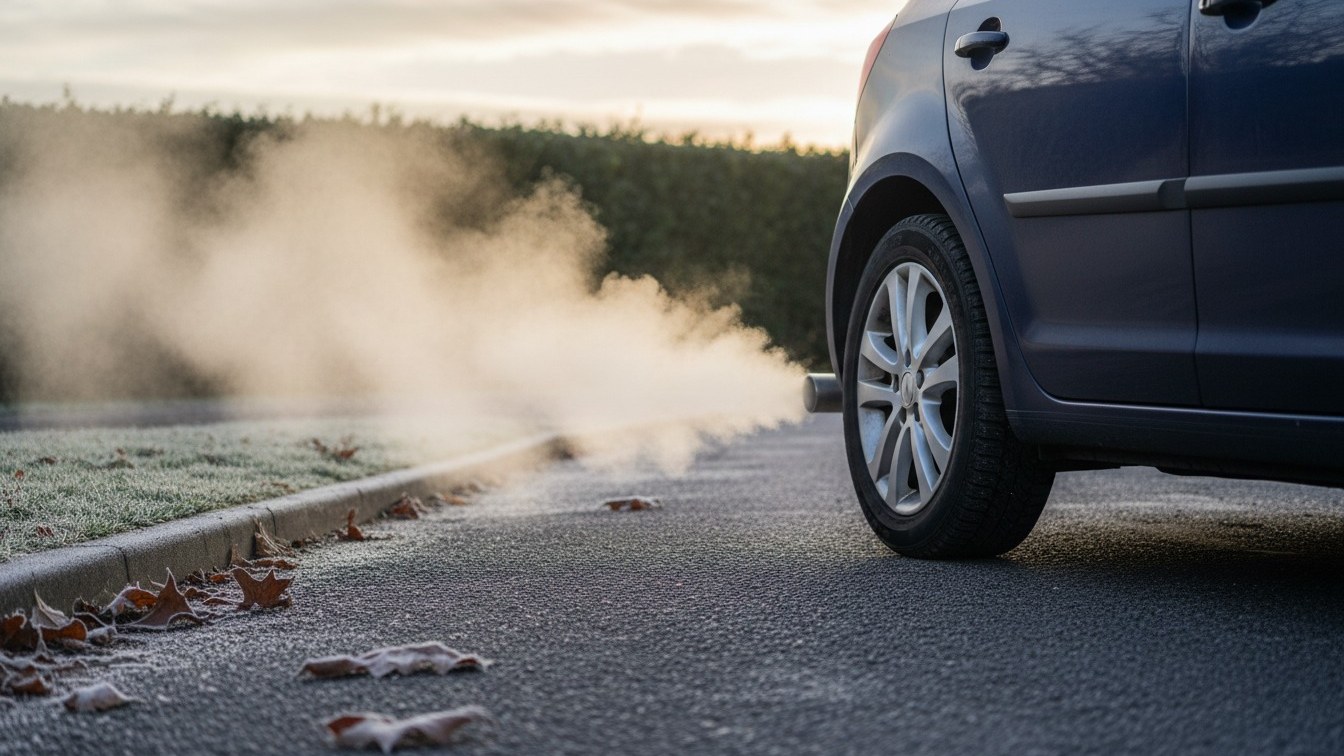
Often, yes. In cold weather, water vapour condenses in the exhaust: Kia’s UK handbook notes that when a vehicle idles for a long time in winter, water collects in the exhaust pipes and is cleared once you drive at medium to high speed2. DENSO, which makes glow plugs, puts it plainly: “It’s not unusual to see white smoke from the exhaust during cold weather, until the engine has warmed up”1.
A diesel with a DPF can also show some white smoke while the filter cleans itself, the process called regeneration. Isuzu’s UK handbook for the D-Max says “white smoke may be temporarily produced from the exhaust pipe” during regeneration, that it “results from combustion of PM” (the soot) and that it “does not indicate a failure”; a long spell of idling can also cause white smoke to be briefly emitted7. Ford’s Transit Custom handbook says the same of a regeneration started by the driver: “you may observe a light amount of white smoke. This is normal”8. Peugeot notes that after a long time at very low speed or at idle, a diesel may in exceptional cases give off water vapour from the exhaust when you accelerate18. How regeneration works, and how to help it along, is in DPF regeneration explained.
White smoke is not normal when it is thick, when it is still there after the engine has warmed up and you have driven for a while, or when it comes with a falling coolant level, a smell of fuel or coolant, or the engine warning light.
Thick white smoke: coolant or unburnt fuel
Coolant being burnt
Coolant that gets into the cylinders or the exhaust can show as white smoke. In one General Motors service bulletin, about engines whose cylinder head gasket may not seal properly, the symptoms listed are overheating with the engine warning light on, coolant or oil with “a thick milky look”, and an “exhaust showing thick white smoke and having a coolant smell”3. On a diesel, the EGR cooler is another way in: Pierburg, which makes them, warns that a leaking EGR cooler can lose coolant slowly, and that “when the engine is switched off, the coolant seeps into the engine’s exhaust tract or intake air system”13.
If the coolant level keeps dropping with no leak you can see, or the temperature gauge climbs, have the engine checked before driving any further.
Diesel fuel that isn’t burning
On a diesel, white smoke is often fuel that has gone through the engine without burning. DENSO explains that “white smoke usually occurs when there is not enough heat to burn the fuel”, and that it “typically produce[s] a rich fuel smell”1. Its list of causes1:
- Glow plugs. Burned-out, carbon-fouled or damaged glow plugs make the engine harder to start as temperatures drop; once it starts it idles roughly and gives “white smoke from the exhaust for several minutes”. A faulty glow plug control module can do the same.
- Low cranking speed, low compression and air in the fuel system.
- White smoke after the engine has warmed up: “one or more bad injectors, retarded injection timing or a worn injection pump”.
Delphi, which makes common-rail injectors, adds that a failing injector can produce more smoke than normal, “either white or black depending on the injector failure mode”, and that on vehicles with a DPF the smoke is less of an issue, “even though it can lead to blocked filters”12. Leaking injectors and glow plug condition are both on the list of checks the manufacturer of our DPFs sets out before a filter is replaced19: see why DPFs block.
Blue smoke: the engine is burning oil
Blue smoke is engine oil being burnt. MAHLE, which makes turbochargers and pistons, says that if an engine “shows signs of increased oil consumption and emits blue smoke, the turbocharger should definitely be included in the root cause analysis”4. But the cause is often outside the turbo. The ways oil gets into the exhaust:
- Oil pushed out of the turbo. A clogged or kinked oil return line, too much oil in the engine, or too much pressure in the crankcase (from worn pistons and rings, or a blocked crankcase breather) stops oil draining from the turbo, and it is forced out into the intake and the exhaust4,14,15. Melett, which makes turbo parts, says the oil drain pipe must be replaced whenever the turbo is, because a clogged drain can make even a new turbo smoke14.
- Worn valve stem seals or valve guides. Oil gets past the valves into the intake or exhaust and burns15.
- Worn pistons, piston rings or cylinder bores. More combustion gas leaks into the crankcase (“blow-by”), and the pressure pushes oil into the intake or exhaust, where it burns15.
- Too much oil. Over-filling makes the oil foam and swamps the crankcase ventilation, so oil is drawn into the engine and burnt. MAHLE’s advice: fill only to the specified maximum4,15.
What it does to the exhaust. Oil ruins a catalytic converter. The manufacturer of the converters we sell lists “oil fouled” among the failures its warranty does not cover: oil gets into the exhaust, contaminates the converter, and “the cat will be unable to convert any gases passing through it and will eventually fail”10. On a diesel, the additives in burnt oil are the main source of the ash that collects in a DPF; the more oil an engine burns, the faster the filter fills with ash and the faster exhaust back-pressure rises11. The ash stays in the filter after regeneration has burnt the soot away11, so the filter has to be cleaned or replaced. Isuzu’s handbook warns that using anything but low-ash engine oil “could result in DPD failure” (DPD is Isuzu’s name for the DPF)20. An ash-loaded filter sets its own fault code: see DPF fault codes.
Check the oil level on the dipstick: a level above the maximum is a fault in itself, and on a diesel it can mean fuel from failed regenerations has got into the oil, which then needs changing19.
Black smoke: too much fuel, not enough air
“Black smoke is caused by an imbalance in the air-fuel ratio – too much fuel and not enough air,” says DENSO1. The parts makers’ own lists of causes include:
- Injectors. A failing injector can cause black smoke as well as white12.
- The air mass sensor. A defective or dirty sensor can send wrong signals, leading to “black smoke, lack of power, limp home function”; a blocked air filter is one of the things that can make even a good sensor read wrongly16.
- A damaged turbo. MAHLE lists black smoke among the effects, because “the engine is not getting enough air; the fuel-air mixture is too rich”4.
- Glow plug faults, which can upset combustion enough to cause black smoke as well as white1.
On a petrol engine, black smoke means the engine is running rich, and that sends unburnt fuel into the catalytic converter. The converter manufacturer names unburnt fuel as the most common cause of a converter overheating or failing: the fuel ignites inside it, and the ceramic core can overheat and melt. Misfires from faulty spark plugs or leads do it, and so can a faulty lambda sensor, fuel injection system or MAP sensor; an overheated converter is not covered by its warranty10. Fix the fuelling first: what causes a faulty catalytic converter has the full list, and if the engine warning light shows P0420, see our P0420 guide.
Black smoke from a diesel with a DPF
A DPF is there to stop soot. In General Motors’ words, “a properly functioning diesel particulate filter should remove most if not all soot particles from the exhaust stream”5. So a DPF-equipped diesel blowing black smoke is telling you one of these:
- The filter is cracked or broken, so soot goes straight through. General Motors links “excessive smoke coming from the tail pipe” to code P2002, which its engines set when they detect “a cracked or broken DPF”5.
- The filter has been removed (code P226D on the same engines5). A vehicle built with a DPF that no longer has one fails the MOT, and using a vehicle modified so that it no longer meets its emissions standard is an offence21: see is DPF removal legal?
- The filter is blocked, or its pressure sensor or pipes have failed. The manufacturer of our DPFs lists black smoke among the symptoms of a filter blocked with soot (P2463) or ash (P242F) and of pressure-sensor faults (P2452, P2453)6. See DPF fault codes explained and DPF pressure sensor and pipes.
Have the fault codes read first: they usually show which of these it is. Our fault codes guide also describes the check General Motors gives its technicians for a filter that lets soot through.
What does grey smoke mean?
Grey is the hardest colour to read, and none of the makers’ guides we used gives it a meaning of its own: they describe white, blue and black. Go by the other signs. An oil level that keeps falling points to oil, as with blue smoke; a falling coolant level or a coolant smell points to coolant, as with thick white smoke; a smell of diesel or petrol points to fuel that isn’t burning1,3,4. A fault code reader will narrow it down further.
Exhaust smoke and the MOT
The tester judges the smoke by eye and, on most diesels, measures it. On a petrol vehicle, the engine is held at around 2,500 rpm for about 20 seconds and the smoke is judged once it has settled back to idle9. On a diesel, a smoke meter measures how much light the smoke blocks, and on a vehicle fitted with a DPF the tester also checks that no visible smoke comes out during the metered test9.
| Defect | Category | Manual reference |
|---|---|---|
| Petrol: dense blue or clearly visible black smoke for 5 seconds in a row at idle | Major | 8.2.1.2 (f) |
| Petrol: excessive dense blue or clearly visible black smoke when accelerating, enough to obscure the view of other road users | Major | 8.2.1.2 (g) |
| Diesel: smoke reading above the limit on the manufacturer’s plate, or above the default limit | Major | 8.2.2.2 (a), (b) |
| Diesel: smoke or vapour of any colour likely to obscure the vision of other road users | Dangerous | 8.2.2.2 (c) |
| Diesel fitted with a DPF: visible smoke of any colour | Major | 8.2.2.2 (d) |
A major defect is a fail: “Repair it immediately”. A dangerous defect is a fail too, and the advice is “Do not drive the vehicle until it’s been repaired”17.
Smoke fails a lot of diesels. In DVSA’s results for initial MOT tests in 2024 and 2025, which we analysed for our MOT emissions failure rates study, 257,051 tests of diesel vehicles failed on smoke readings over the limit (8.9 per 1,000 tests), and 17,083 failed because a vehicle fitted with a DPF gave off visible smoke: about two thirds of all DPF-related failures22. The models with the highest rates of that second failure are in the table further down. For what a smoke reading on your MOT printout points to, see failed your MOT on emissions?
Can you drive a vehicle that’s blowing smoke?
The normal vapour of a cold start, and a little white smoke while a DPF regenerates, are nothing to worry about. Beyond that, the law is clear. The Road Vehicles (Construction and Use) Regulations 1986 require every vehicle to be “constructed and maintained so as not to emit any avoidable smoke or avoidable visible vapour”, and no one may use a vehicle on a road if the smoke or vapour coming from it “causes, or is likely to cause, damage to any property or injury or danger” to anyone on the road23. On a diesel, smoke or vapour likely to obscure other road users’ vision is also a dangerous defect at the MOT9. So:
- Thick smoke of any colour that obscures the road: don’t drive it.
- White smoke with a falling coolant level or a rising temperature gauge: stop and have it checked.
- Blue or black smoke: have it diagnosed soon. Every mile burns oil or unburnt fuel through the catalytic converter or DPF, which is how a fixable engine fault turns into a new exhaust part as well10,11.
Fix the cause before you replace a catalytic converter or DPF
A new catalytic converter will not stop an engine smoking: the smoke is made in the engine, and the same oil or fuel would ruin the new part. The manufacturer’s warranty on the converters we sell excludes converters that are oil-fouled, plugged or contaminated by an engine that has been running poorly, or overheated by unburnt fuel, and it won’t accept an emissions failure with hydrocarbons above 60 ppm, which “usually indicates a vehicle fault”10. Before a DPF is replaced, the same manufacturer has the garage check the EGR valve and its pipe, the injectors for leaks, the glow plugs, the air filter, the air flow meter, engine and turbo wear, the sensors, and the oil’s type and level19. Those are the smoke causes above. More in how to claim on a catalytic converter or DPF warranty.
Once the cause is fixed, a new part is the answer when the old one has failed: a DPF that is cracked and lets soot through, or a converter that has melted or been fouled with oil5,10. After a new DPF is fitted, any fault codes are cleared, a forced regeneration is run and the engine computer is reset19, as set out in how to replace a DPF; for converters, see how to fit a catalytic converter.
DPFs for the diesels most often failed for visible smoke
The diesel models most often failed at the MOT for visible smoke from a vehicle fitted with a DPF (models with at least 20,000 initial tests in 2024 and 2025; the rate for all diesels was 0.6 per 1,000 tests)22, with the number of DPFs and combined catalytic converter and DPF units we list for each on 7 November 2026. Each page lists every part by engine, with today’s price.
| Vehicle | Failures per 1,000 tests | DPFs and combined units |
|---|---|---|
| Ford Fiesta | 3.9 | 8 |
| Peugeot Bipper | 3.8 | 1 |
| Fiat Doblo | 3.6 | 6 |
| Mazda 6 | 3.2 | 7 |
| Citroen Nemo | 3.1 | 1 |
| Vauxhall Antara | 2.2 | 2 |
| Mazda 3 | 2.1 | 9 |
| Saab 9-3 | 2.1 | 2 |
| Vauxhall Mokka | 2.1 | 1 |
| Mazda CX-5 | 2.1 | 1 |
Every part lists the vehicles and years it is catalogued for, so check it against your vehicle. All carry a 2-year warranty (3 years on the Premium range), are backed by our fitment guarantee, come with the matching fitting kit free where the part needs one, and are delivered free to most of the UK, next working day on orders placed before 4pm, Monday to Thursday. Browse DPFs, combined catalytic converter and DPF units and catalytic converters, or choose your vehicle from the vehicle list.
Frequently asked questions
Is white smoke from the exhaust normal?
On a cold start, yes, as long as it is thin and clears once the engine has warmed up1,2. Some diesels also give off a little white smoke while the DPF regenerates7,8. Thick white smoke that stays, especially with a falling coolant level or a smell of fuel, is a fault1,3.
Why is there white smoke from my exhaust when I accelerate?
After a long spell at very low speed or idling, a diesel may give off some water vapour when you accelerate; Peugeot says this does not affect the vehicle18. If it carries on once the engine is warm and you have driven for a while, look for the causes of thick white smoke: injectors, timing or coolant1,3.
Can a blocked DPF cause black smoke?
Yes. The manufacturer of our DPFs lists black smoke as a symptom of a filter blocked with soot or ash, and of a faulty DPF pressure sensor or its pipes6. A cracked filter can smoke too, because soot goes straight through it5. The fault codes tell you which: see DPF fault codes.
Will a new catalytic converter stop the smoke?
No. Smoke comes from the engine: oil, coolant or fuel that shouldn’t be in the exhaust. A new converter does not stop it, and the same fault would ruin the new part, which its warranty would not cover10. On a diesel whose DPF has cracked, a new DPF does stop soot getting through5, once whatever damaged the old one has been put right.
Will a smoking exhaust fail the MOT?
Dense blue or clearly visible black smoke from a petrol engine for 5 seconds at idle is a major defect. A diesel fails on a smoke reading over its limit, and a diesel fitted with a DPF fails on visible smoke of any colour. On a diesel, smoke or vapour of any colour likely to obscure other road users’ vision is a dangerous defect9.
Is it illegal to drive with smoke coming from the exhaust?
Vehicles must be built and maintained not to emit avoidable smoke or visible vapour, and it is against the law to use one on the road if its smoke causes, or is likely to cause, damage, injury or danger23. If yours is smoking heavily, have it fixed before you drive it far.
Sources (accessed 7 November 2026)
- DENSO Aftermarket Europe, “Six signs it’s time to replace your glow plugs” (2020): white smoke, black smoke. denso-am.eu
- Kia, owner’s manual (UK, 2023 web edition), “Winter driving”: water vapour in the exhaust pipes. ownersmanual.kia.com
- General Motors, Service Bulletin 22-NA-030, February 2022 (engine block deck flatness and cylinder head gasket seal, LFY engine), published by the US National Highway Traffic Safety Administration. static.nhtsa.gov
- MAHLE Aftermarket, “Turbochargers: damage scenarios, causes, remedies, and avoidance” (2024): oil leakage; lack of lubrication. mahle-aftermarket.com
- General Motors, Service Bulletin 16-NA-380, “Diagnostic tip for MIL illuminated, excessive smoke from tail pipe: DTC P2002, P226D and/or P244A set”, September 2022, published by the US National Highway Traffic Safety Administration. static.nhtsa.gov
- BM Catalysts, “DPF & Catalytic Converter Common Fault Codes Guide” (FAULTCODES_V01, January 2024): P242F, P2452/P2453, P2463. bmcats.com
- Isuzu, D-Max owner’s manual (2017 model year, UK): “Diesel Particulate Defuser (DPD)”, pp. 2-73 to 2-74 and 4-184. isuzu.co.uk
- Ford, Transit Custom owner’s manual (CG3763en, edition 2019-11, UK English): “Diesel Particulate Filter”, manual regeneration, p. 150. fordservicecontent.com
- DVSA, MOT inspection manual for private passenger and light commercial vehicles, section 8: Nuisance (8.2.1.2 Gaseous emissions; 8.2.2.2 Opacity). gov.uk
- BM Catalysts, “Catalytic Converter Warranty & Fitting Advice”: catalyst replacement guide and warranty advice. bmcats.com
- Manufacturers of Emission Controls Association (MECA), “Diesel Particulate Filter Maintenance: Current Practices and Experience”, June 2005, published by Transport Canada: ash and oil consumption. tc.canada.ca
- Delphi Technologies, “Diagnosing common rail injector failure symptoms” (Ford Mondeo 2.0 TDCi): excessive exhaust smoke. delphiautoparts.com
- Pierburg (Motorservice), Service Information SI 1003, “Creeping coolant loss: leaky EGR coolers often go unnoticed”. techtips.ie
- Melett, “Turbo failures by turbo OE number”: blocked breather; oil drain pipe. melett.com
- Motorservice (Kolbenschmidt, Pierburg), “Oil consumption and oil loss” (edition 10/2014): sections 2.2, 2.5 and 2.6. techtips.ie
- Motorservice (Pierburg), “Air mass sensors”. ms-motorservice.com
- DVSA, “MOT changes: 20 May 2018” (defect categories; diesel vehicles with a DPF). gov.uk
- Peugeot, 208 handbook (edition 01-16): “Particle filter”. public.servicebox.peugeot.com
- BM Catalysts, “Diesel Particulate Filter Information & Fitting Advice” (DPFFA_V01): initial investigation and diagnostic checks. bmcats.com
- Isuzu, D-Max owner’s manual (2017 model year, UK): engine oil, p. 2-73. isuzu.co.uk
- Department for Transport and DVSA, “Diesel particulate filters” (guidance note, updated 4 December 2013): legal requirements and the MOT test. gov.uk
- Driver and Vehicle Standards Agency, “MOT Anonymised Data”: test results and failure items for 2024 and 2025 (initial tests of class 4 and 7 vehicles), analysed by CatHive in MOT emissions failure rates by model. open.data.dvsa.gov.uk
- The Road Vehicles (Construction and Use) Regulations 1986 (SI 1986/1078), regulation 61(1) and (5)(a): emission of smoke, vapour, gases, oily substances. legislation.gov.uk